









Accelerating the flow of discovery
ASU researcher Mohamed Houssem Kasbaoui receives NSF CAREER Award to explore fluid dynamics simulations

Mohamed Houssem Kasbaoui, an assistant professor of mechanical and aerospace engineering in the Ira A. Fulton Schools of Engineering at Arizona State University, poses for a photo in front of a colorful background. Kasbaoui recipient earned a 2025 National Science Foundation Faculty Early Career Development Program (CAREER) Award, is to pioneering faster fluid dynamics simulations to accelerate innovation across science and engineering. Photographer: Erika Gronek/ASU
When it comes to advancing science, speed matters. Mohamed Houssem Kasbaoui, an assistant professor of mechanical and aerospace engineering in the School for Engineering of Matter, Transport and Energy, part of the Ira A. Fulton Schools of Engineering at Arizona State University, wants to know how researchers can run complex fluid dynamics simulations in hours instead of months without sacrificing accuracy.
The pursuit of that challenge has earned Kasbaoui a 2025 National Science Foundation Faculty Early Career Development Program (CAREER) Award.
Kasbaoui joined ASU in 2019 after completing a postdoctoral fellowship at the University of Texas at Austin and earning his doctorate from Cornell University. From the beginning, his work has been driven by a central problem.
“Despite the tremendous growth in computing power, numerical simulations of turbulent flows around complex and deforming objects are incredibly computationally intensive,” Kasbaoui says.
These simulations support advances in environmental science, biomedical engineering and aerospace design, yet even the world’s most powerful computing systems can take months to complete a single high-fidelity run, creating a bottleneck for innovation.
“The computing power required for these simulations is orders of magnitude larger than what is afforded by the largest supercomputers,” Kasbaoui says. “This high cost chokes progress in many fields that rely on such numerical calculations for design optimization or predictions.”
His CAREER Award project investigates new simulation techniques that aim to decrease the computational cost. With these methods, the calculation time can be reduced from months to hours, thereby enabling faster turnaround for design iteration and quicker science discovery.
Kasbaoui will tackle this challenge by combining turbulence models with a new mathematical approach for handling complex surfaces, and then running the calculations on supercomputers.
“The novelty resides in how theory is infused in the numerical methods,” he says. “With existing methods, flows I’m working on require very intensive brute-force number crunching to get high-fidelity predictions. Instead of doing this, I propose to find approximate answers that still retain very high fidelity but have dramatically lower computational cost.”
Kasbaoui feels his proposal was selected for its transformative potential. Reducing simulation time from months to hours has far-reaching implications for engineering, environmental and biomedical applications.
“Our methods can enable faster design iteration, accelerate scientific discovery and open doors for researchers without access to massive computing resources,” Kasbaoui says.
His lab is building a suite of computational tools and software to implement these cost-reducing method. Long-term, these tools will be applied to a wide array of problems, including environmental flows such as sediment transport and , biomedical flows such as heart valves and airways, and engineering applications like biofouled surfaces, bio-inspired propulsion and drag reduction. These areas hold significant untapped potential, hindered until now by the lack of efficient numerical tools.
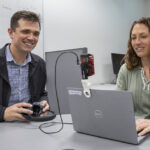
Among the goals Kasbaoui has for this project is to build a digital learning environment for fluid dynamics in augmented and virtual reality at ASU.
“This will provide a research opportunity to mechanical and aerospace engineering undergraduate students interested in building this platform,” Kasbaoui says. “Once completed, this platform can be used as modern way of teaching fluids and will be a way of engaging young learners at ASU K-12 outreach events.”