













Algae-powered innovation
Prolific aquatic organisms provide promising paths to green energy production, food and water security
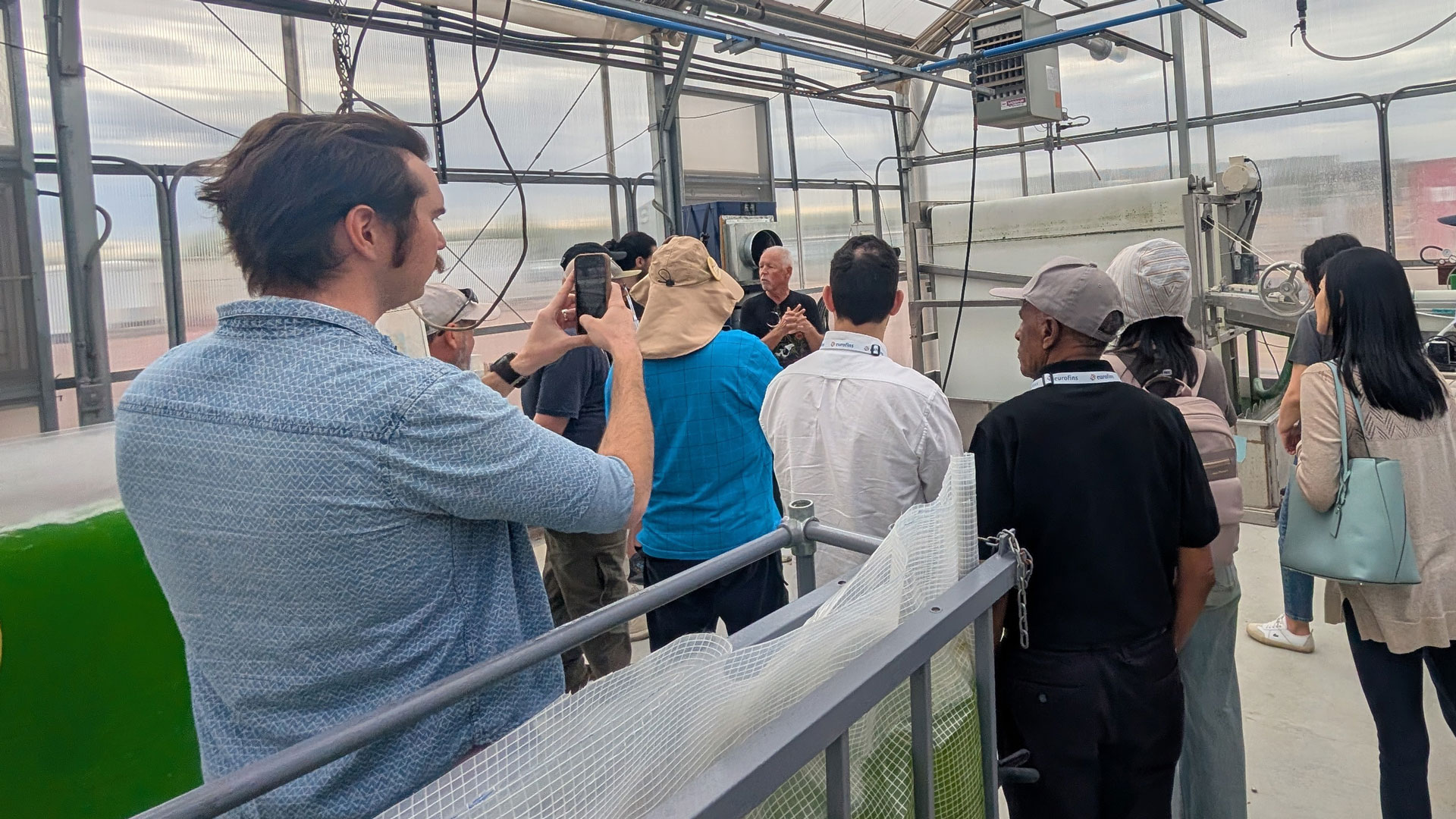
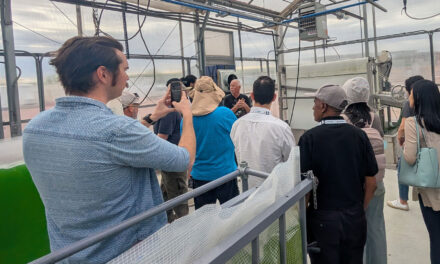
Peter Lammers (standing in background) a researcher professor in the School of Sustainable Engineering and the Built Environment, part of the Ira A. Fulton Schools of Engineering at Arizona State University, and chief scientist for the Arizona Center for Algae Technology and Innovation, addresses visitors touring the center’s facilities on the ASU Polytechnic campus. The center advances algae-based solutions for food, biofuels, water treatment and soil health. Photographer: John McGowen/ASU
Coontrary to common perceptions, the diverse group of organisms called algae are all not classified as plants. They have neither the roots, stems, leaves, nor cellular reproductive structures of typical plants. But that in no way diminishes algae’s value.
Many of the hundreds of thousands of algae species, and millions of strains, are being explored as an agricultural crop for feed, food, fuels and bioproducts. Algae can produce far higher yields than terrestrial crops, but with the capacity to grow on non-arable land using non-freshwater sources.
Arizona State University researchers are working to expand algae’s potential by addressing the current risks of large-scale algae cultivation.
Established in 2010 on ASU’s Polytechnic campus the Arizona Center for Algae Technology and Innovation, or AzCATI, has become a leading testbed and research facility for algae innovation.
Directed by the Ira A. Fulton Schools of Engineering at ASU, AzCATI is also part of ASU’s Lightworks, an accelerator that focuses on advancing solar energy generation and other sources of sustainable energy and fuels.

Visitors at ASU’s Polytechnic campus view a commercial pilot-scale, flat-panel photobioreactor developed by the company Pure Biomass company at the Arizona Center for Algae Technology and Innovation, or AzCATI, testbed facilities. Photo courtesy of Arizona Center for Algae Technology and Innovation
Putting ASU on the algae research map
AzCATI was launched with a multimillion-dollar investment from Science Foundation Arizona, a nonprofit with the mission of diversifying Arizona’s economy by aligning university research with industry needs.
The foundation’s support funded the development of several acres of algal growth ponds on the Polytechnic campus at ASU. Located close to biochemical and molecular biology labs, the ponds provide resources available for use in AzCATI’s projects, particularly the cultivation of algal biomass for biofuels, wastewater treatment and other bioproducts.
Soon after its establishment, AzCATI expanded research into nutraceuticals, biofuels, food and feed, soil amendments and biostimulants, and high-value pharmaceuticals — all derived from algae biomass.
That momentun was driven largely by securing federal funding for algae research and development, primarily through the Department of Energy, including two major consortium projects led by AzCATI: the Sustainable Algae Biofuels Consortium in 2010 followed by the Algae Testbed Public Private Partnership, or ATP3 funded in 2013.
The public-private partnership provided resources to develop multiple sites to test various algae cultivation techniques.
“Its success was basically how we began truly expanding over the years to put ourselves on the map in the context of operating as a major test bed for moving algae biotechnology forward,” says ASU sustainability scientist John McGowen, director for AzCATI.
“We’ve become basically the extension resource for algae farmers from many public and private ventures that need to make advances in algae cultivation and productivity to reach their goals,” McGowen says. “We collaborate with industry and academics to road-test technology and use data being generated by our testbed site to contribute to reducing technology risk and helping to propel the success of these enterprises.”
The center now has longstanding working relationships with major U.S. research facilities, including the National Renewable Energy Laboratory, the Pacific Northwest National Laboratory , Los Alamos National Laboratory and Sandia National Laboratories.
“Most of the national labs don’t have access to their own outdoor testing facilities, so they can come to us,” McGowen says. “Recently, through the DOE-funded DISCOVER consortium, we’ve achieved some of the highest outdoor algae cultivation productivity rates ever reported.”
AzCATI plans to continue supporting researchers in algal biotechnology by expanding opportunities for students to get involved in its work and providing resources that help them prepare for careers aligned with the center’s mission.
More than 200 undergraduate students and nearly two dozen graduate and postdoctoral students have gotten involved in AzCATI’s work, McGowen notes. He adds that a significant number of undergrads move up into research staff positions after graduation and many also go to work in an array of industries.
“AzCATI’s progress is enabled by ASU’s strong commitment to supporting undergraduate and graduate research opportunities. We could not accomplish what we have accomplished without our undergrad and graduate researchers,” he says.

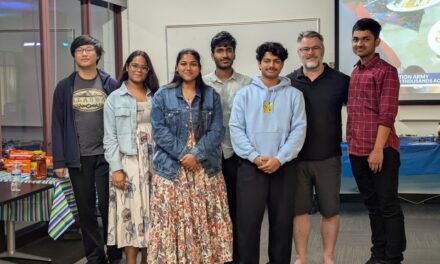
Pictured at the 2025 Algae Biomass Summit hosted by Arizona State University are (left to right) ASU graduate students Zhanyi “Richard” Wang and Michelle Tan; senior research specialist Aaron Geels , New Mexico State University postdoctoral student Thuy Nguyen; and ASU graduate student Maryam Younan. Photo courtesy of Arizona Center for Algae Technology and Innovation
Research collaborators rely on AzCATI’s expertise and creativity
The center’s leadership in algae R&D was on full display in October when ASU and AzCATI co-hosted the Algae Biomass Summit with the Algae Biomass Organization, or ABO, in October.
In addition to co-hosting the conference, AzCATI’s achievements were featured throughout the program, including in multiple conference talks. The celebrations culminated in marking AzCATI’s 15 years of service to the algae research and development community, followed by a reception and a tour of its facilities.
This marked the third time the summit has taken place in Arizona, including in 2010 when AzCATI’s establishment was first announced and again in 2016. Based on the success of this year’s summit, the ABO board of directors unanimously decided to have ASU and AzCATI cohost the 2026 Summit which will celebrate the 20th anniversary of the Summit.
Kevin McGraw, ABO’s interim executive director and director of sales for Algaewheel — an innovative bio-engineered, nature-based wastewater treatment technology — has nearly two decades of experience in the algae industry and is a strong collaborator and advocate for AzCATI and the broader algal community.
“I think algae can be used to further improve food nutrition, produce more sustainable fuels and develop an environmentally cleaner way of treating wastewater, among many similar uses,” McGraw says.
“ASU has become a major research center for algae innovation,” says Everett Eustance, AzCATI’s assistant director and chair for both the 2025 and 2026 Algae Biomass Summit, “and I am excited that we can bridge the world of research and commercialization through the Algae Biomass Summit.”
Through its connections to LightWorks and the Fulton Schools and organization such as ABO, and it collaborations with national labs, AzCATI has been able to draw on a broad array of engineering and science resources and expertise, helping ASU and the center attract close to $100 million from public agencies, industry and foundations.
AzCATI has also partnered with startups to secure small business innovation grants, leading to significant expansion of its activities throughout the past 15 years.
Over that time, the use of algae in products has continued to increase. Algae is now an ingredient in foods for both humans and animals, as well as cosmetics, nutritional supplements such as omega-3 oils, antioxidants, coloring agents, dyes for fabric, sunblock lotion, printing ink, and other consumer products.
McGraw and his company have been collaborating with McGowen and his team to explore the vast possibilities for new algae-based applications.
“It’s a promising collaboration of friendship and a determination to get algae into the commercial world,” says McGraw, who has been working with McGowen for many years and sees AzCATI at ASU as the top proving ground for algae technology in the U.S.
McGowen says AzCATI is well positioned to continue advancing algae biotechnology, particularly by improving and expanding the use of algae-based processes and technologies that benefit not only commercial interests, but also environmental goals and the broader public good.

A 15-liter flat panel photo-bioreactor used for the scaling up algae culture pictured before it is taken outdoors for cultivation is one of the high-tech systems being used by researchers at ASU’s Polytechnic campus to realize the potential for using algae to produce green renewable energy. Photo courtesy of Arizona Center for Algae Technology and Innovation
Algae’s blossoming potential promises impactful progress
Despite the persistent challenges of achieving revolutionary breakthroughs in clean, economical and accessible energy, McGowen sees strong near-term potential for algae-based biotechnology, particularly in food and feed, wastewater treatment, soil health, and creating a more sustainable, circular economy.
The breadth and potential impact of AZCATI’s work is reflected by an ambitious project led by its chief scientist, Research Professor Peter Lammers and Associate Professor Elham Fini, both in the School of Sustainable Engineering and the Built Environment, part of the Fulton Schools, that examines the impact of diverting high-strength wastewater to direct algal treatment and subsequent conversion of algal biomass into bio-products such as bio-asphalt.
Lammers says life-cycle modeling predicts the technology will lower energy costs and reduce environmentally harmful greenhouse gas emissions by 50%. Currently the wastewater is recycled back to the front end of the plant, creating a parasitic load on the secondary treatment process.
If successful, the technology will link wastewater treatment and biomanufacturing opportunities, he says. To help realize that goal, Lammers has formed a new company to explore ASU’s technology for reimagining wastewater treatment.
“Algae can support food, fuels and energy, but the challenge is scaling. That’s one of the biggest challenges we have always faced,” McGraw says. “However, I think the potential is emerging for algae production and its uses to multiply to the point where it can be a major source of enhancement for society’s progress.”
McGowen says as algae cultivation contiues to improve and innovation accelerates, he also foresees progress toward the long-term goal of cost-effective biofuels, including sustainable aviation fuel.
“If we do it all right, algae biotechnology can deliver substantial environmental and economic benefits and contribute to broader food, water and energy security,” McGowen says. “As we have been doing for the past 15 years, ASU and AzCATI will continue to be at the forefront.”